Shoulder Rotator Cuff Injury and Cure

Dangerous Shoulder Exercises Article

Discover How a Medically Proven Exercise Program
Designed by a Physical Therapist Will Finally Allow You
to Stop Relying on Medications, Injections and Other 
Useless Remedies to Eliminate Your Rotator Cuff
Pain
and Prevent Future Shoulder Injuries.

"Brent.

I have to write to you.  I took your advice on getting Brian's eBook and I'm amazed.  That simple book has changed my life.  I'd been suffering with my rotator cuff shoulder injury for almost a year.  I hadn't been able to play tennis for 10 months.  Just misery.

I couldn't believe how quickly Brian's advice and methods worked.  I'm finally back out on the tennis court and my shoulder feels better than ever.  In fact, I'm hitting my serves and overheads with much more power than I did before.

Thanks Brent and please feel free to use my comments as you want."

John W.
Scottsdale, AZ

There is more than hope, there is a REAL solution,
and this simple & fast method to cure
your shoulder rotator injury without surgery & injections
Can Work For You...

Hi, Brent Abel here, and as a tennis teaching professional for over 35 years and I've seen my share of shoulder rotator cuff injuries out there in the tennis world.  And on the golf course, and folks who fly fish, and on and on...

And I know that shoulder injuries are not just restricted to tennis players.  Almost any sport has a risk for shoulder injuries.  Heck, general activities in our day to day lives make us susceptible to shoulder injuries.

I've seen the frustration of tennis players who so desperately want to get back out on the court to play their beloved tennis, but because of too much shoulder pain or very limited range of motion, they're just unable to do so.

Fighting Through the Pain

I've also seen players who sort of just fight through the pain, try to mask it with tons of Ibuprofen or the like, and end up doing serious damage to their shoulder.

I've never been one to suggest invasive solutions to cure injuries.  I don't know, I've always felt the body wants to heal itself.  There are certainly drastic injuries that require major surgery, but from my experience, most injuries can be cured without invasive measures.

To repair any injury without surgery, meds, injections, etc. requires not only the right information, but the correct sequence, the right formula for enabling the healing process.

The Proper Sequence is the Cure

Ice all you want, apply heat all you want, stretch all you want, strengthen all you want, whatever, but if you don't do it in the right sequence, you'll probably never get better, and worse case you may even do more damage to your shoulder.

As a tennis teaching professional, I really understand the value of fundamentals and learning those fundamentals in a specific sequence. 

Repairing injuries, and specifically shoulder injuries, requires that same philosophy.  There are true, non artificial, fundamentals to quickly start the healing process, to promote further healing through specific stretching and strengthening techniques, and eventually to get you cured and ready to go back out there and enjoy your sport and your day to day life in general.

Start Your Healing Process in the Next 3 Minutes

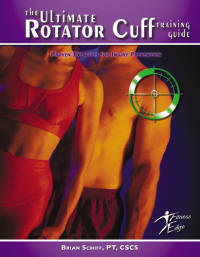
Brian's Schiff's eBook The Ultimate Rotator Cuff Training Guide is all about just that, getting you the correct, no nonsense, help right now so you can get back doing what you love to do, whether it's tennis, golf, whatever, just plain living, and showing you how to prevent future shoulder injuries...

I bought Brian's eBook and really picked it apart.  I read it three times just to be sure I wasn't missing anything.  I really looked for flaws. 

I couldn't find any.

Brian's approach is strictly no nonsense, my kind of information.  No fluff, straight to the point, easy to understand, and with a theme of getting you back out there quickly and pain free.

If you're sick and tired of putting up with your shoulder rotator injury, and not interested in surgery, medications, injections, and other invasive so called fixes, then relax, there is a solution.

Brian's methods work.  His methods are guaranteed.  You've got nothing to lose.

"Prior to working with Brian Schiff, I was diagnosed with a left rotator cuff tear and tendonitis in both shoulders

After following his rotator cuff training program  in therapy, I regained full motion, strength and use of my arms again. 

Since I work as a dental hygienist, this was critical in allowing me to work without limitation and pain. 

I respected his expertise so much that I decided to hire him for    personal training to continue strengthening and prevent a future injury.  As a fellow medical professional, I am critical of other medical professionals, but when it  comes to fitness training his methods and medical expertise are second to none!"

Donna Newman

I'm more than happy to answer any questions you may have.  Feel free to email me at brent@webtennis.net.

If you're finally fed up with your shoulder pain, if you're really ready to take the proper action to get cured today, then check out Brian's eBook.  Click here now.  
 

Dangerous Shoulder Exercises
By Brian Schiff

Have you ever suffered from shoulder discomfort after working out? I am referring to aching or sharp pain experienced in the front of the shoulder or lateral upper arm that is felt with overhead activities, reaching behind the back or even laying on the shoulder. These symptoms are often indicative of rotator cuff inflammation. This is a common problem for many people who perform resistance training on a regular basis. It is also a problem that can easily be prevented by modifying the following “dangerous shoulder exercises.”

Bench Press – This is a popular exercise chosen to build the chest, along with the anterior deltoid and triceps. Most teach taking the bar down until it lightly touches the chest. However, I believe this is unsafe because it exposes the anterior shoulder capsule to excessive load, in addition to compressing the soft tissue of the rotator cuff between the humerus and the acromion. Over time, with repeated bouts and heavy loads, the rotator cuff becomes inflamed.

Individuals with any anterior shoulder laxity (loose joints) or history of subluxation/dislocation are also at increase risk for rotator cuff injury or labral (shoulder cartilage) damage. Furthermore, you also have the potential to rupture the pectoralis tendon with full range pressing during heavy loads. The safe answer is to lower the bar until the upper arm is parallel to the floor (elbow bent to 90 degrees). This prevents the shoulder joint from moving into the unsafe range. The same advice applies to push-ups.

Lat Pull Downs – This is a good exercise to strengthen the back, but when done behind the head it can cause problems. Like the bench press, pulling the bar down behind the head positions the humerus in such a way that the rotator cuff can be pinched. This may depend on other factors, including the shape of a person’s acromion and degree of any present arthritis, but I still believe the risk outweighs any benefit. Not to mention that keeping the bar in front of the head still accomplishes the same movement for the target muscle, while eliminating the risk of shoulder injury. Remember not to sway during the movement, and position the body in a slightly reclined position, pulling the bar toward the sternum. Another unrelated reason not to do behind the neck pull downs is that it places undue stress on the cervical spine.

Military Press – This exercise when performed behind the neck with a bar, positions the shoulder in the aforementioned unfavorable position. Done repeatedly, the rotator cuff can become inflamed. Similar to behind the neck pull downs, you also expose your neck to unnecessary stress. It is safer to perform the exercise in front of the head or utilize dumbbells and work in the scapular plane. You must watch to avoid arching the low back and it is best to use a bench with back support to prevent this.

Dips/Upright Row – As before, the key mistake made with these exercises is allowing the shoulder to move beyond 90 degrees relative to a position parallel to the floor or perpendicular to the body. I always recommend stopping at 90 degrees to protect the shoulder capsule and the rotator cuff.

Dumbbell Lateral Raise – In my opinion, this exercise is often done incorrectly. The mistakes include lifting too much weight, keeping the arms straight, and raising the arms out away from the body in the plane of the body. The force on the rotator cuff reaches 90% of your body weight when the arms are raised to 90 degrees with the arms straight and in the plane of the body. That is a lot of force on four relatively small rotator cuff muscles. The target muscle is the lateral deltoid, but the rotator cuff is extremely active, and it functions to allow you to raise the arm by depressing the humerus so that it passes under the acromion during active elevation. When heavy loads are introduced in the wrong plane of motion, disaster usually occurs. I am fanatical about performing this exercise correctly.

The proper way to execute a lateral raise is to keep the elbows comfortably flexed (20-30 degrees) and raise the arm to no higher than parallel to the floor. The arm should be in the scapular plane of motion (approximately 30-45 degrees from being perpendicular to the body) and the weight should be relatively light. Once you feel you have to shrug or use momentum to raise the weight, you need to rest or lower the weight. In my opinion, this is one of the worst exercises for the shoulder if done incorrectly.

In summary, I want to emphasize that good intentions may spell bad results for the shoulder if proper form is lacking. The rotator cuff and shoulder joint is extremely vulnerable to heavy loads and repetitive bouts of exercise. Gradually, it may become inflamed and hinder or limit your workout altogether. Be sure to master form before increasing weight, and do not attempt to work through pain, as this often perpetuates the problem. Remember to assess risk and reward at all times, and rest assured that these modifications will not hinder your gains. Instead, they will prevent missed time in the gym and produce happier, healthier shoulders!

Copyright © 2004 Brian Schiff.

Brian Schiff, PT, CSCS, is a respected author, physical therapist and fitness expert. To learn more about preventing shoulder injuries or resolving rotator cuff pain,

click here

BRIAN SCHIFF, PT, CSCS

Brian graduated from The Ohio State University in 1996 with a Bachelor of Science degree of Physical Therapy in Allied Health Professions.

Since then, he has practiced as a licensed physical therapist specializing in sports medicine.

Through the National Strength and Conditioning Association, Brian became a certified strength and conditioning specialist (CSCS) in 1998.

He is a founding member of The American Association of Personal Trainers, and recently contributed a chapter on periodization to a fitness book entitled The Power of Champions.

Schiff also co-authored a breakthrough manual on ACL injury prevention entitled Protecting the Athlete’s Knee and contributed three chapters in a much awaited golf conditioning e-book entitled Fitness Secrets of Championship Golfers.

Currently, he owns Fitness Edge, a private fitness studio, and co-owns a performance enhancement company, Fitness Edge Performance, specializing in sport specific training programs for athletes of all sports and ages.

Brian is also a strength and conditioning coach for The Columbus Crew Major League Soccer Team.

He has presented at professional conferences and coaches’ clinics on topics including training for shoulder stability, baseball specific training, soccer specific conditioning and sport specific training.

Top of the Page